
Jameela Elfaki is the founder and editor-in-chief of Azeema, a platform dedicated to authentically representing womxn from the Middle East, North Africa, and South Asia. She is known for her impactful contributions to the creative agency landscape and her vision for making a difference in commercial, fashion, and media sectors.
Azeema
Building a magazine and movement that champions women of dual heritage
“Authenticity in representation is not just about visibility; it's about creating space for diverse voices to redefine narratives.”
Transcript: May contain minor errors or formatting inconsistencies.
So for those of you who don't know azima is a collective a magazine and most recently also a creative agency which champions representation of women from the middle east north africa and south asia and beyond it was set up by founder and editor jamila elfaki as her final major project at central saint martins now jamila is joining us this evening to talk us through basically how this uni project blossomed yeah into a kind of amazing hybrid that is azima today so jamila if you could turn on your audio and video as well if you're there hello hi how are you doing yeah well good where are you where are you calling in from your number well.
This is currently currently calling from azima hq in london right nice right right. And I guess like you guys are very much like a collective I mean that must be tricky kind of collaborating when you're all kind of yeah I guess like in different parts of the country or different parts of the world and trying to collaborate on something how's that been in lockdown it's pretty much the same. Actually the only difference is that we can't meet up in person and have our meetings or we can't shoot the things for the next issue so we've kind of it's kind of changed the way that we work in that way.
But we kind of are remote anyway.
So we're always talking over what's up or over emails so in some ways it's changed and in some ways it hasn't so yeah yeah it sounds like you're quite well set up for the the lockdown okay I'm going to leave you to share your screen now and start your presentation and hope this works we have yeah we tested it it looked good hey let me see and just for everyone else again that q a function is there if you if you want to put a question to jamila for afterwards it looks like it's working so I'm gonna I'm gonna duck away great so yeah I'm jamila I am the founder and the editor-in-chief of azuma and matt kindly introduced me there azima is a magazine platform and now a creative agency celebrating women from the middle east north africa and south asian diasporas and beyond it's a bit of a mouthful but incredible so I'm going to start with a little bit about me.
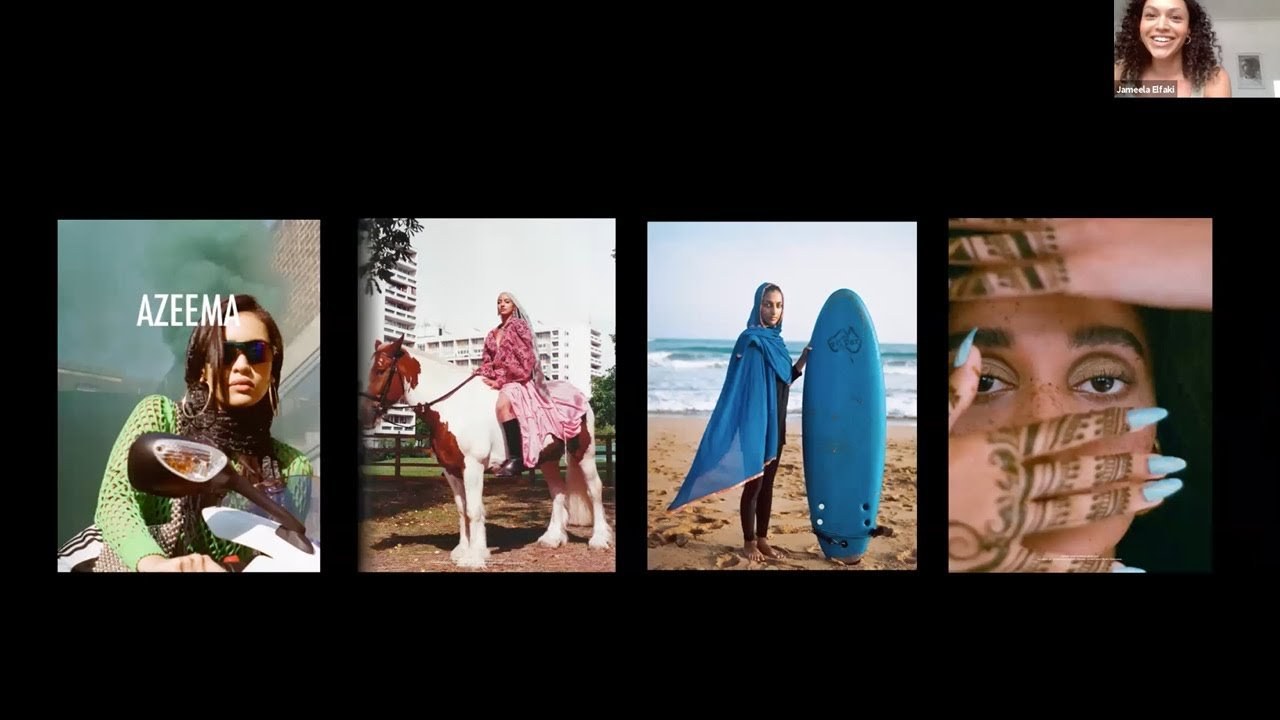
So this is me. And I'm half sudanese half english and I'm based in london. And I just wanted to show you some of my work because I am a photographer so a lot of my work is I just I shoot a lot for the magazine as well. And I'm the creative director of azima so I basically look after all of the visual elements to the magazine and the overall kind of visual identity of the mag and a lot of my work focuses on the visibility of women of color that's super important to me and kind of exploring heritage through visual arts let me just okay.
So the first issue came about as my final major project at university and it was a solo project at the very beginning and I studied fashion communication and promotion at centuries at martins and it was a really diverse course that kind of pushed us to our absolute limits creativity creatively and they pushed you to make some kind of publication or magazine at the end and azima was kind of a it came out of like feelings of frustration and there being like a lack of representation for women like myself with dual heritage feeling disconnected from the motherland and your your background and I really wanted to make something that kind of brought all of that together.
So the visuals that I have on the screen now are from the first issue and yeah.
I think this issue is is the I mean they're all really special to me each one that we've made but I think this one's got to be the most special as it was the first one but yeah it was really born out of a place of like discomfort with my own identity and it really served as an outlet to explore this.
But yeah I guess one of the things I didn't realize when I was making the first issue is how much it would resonate with other people.
And I was flooded with messages from other young women and everyone saying how much they appreciated what I'd made and so it was such a surprise but like really amazing as well. And I guess from there we a team kind of formed and this is a little polaroid of us minus one but this is my incredible team and we work together now to make the the magazine happen the issues the content for online and on the agency but yeah kind of briefly sum everybody up I have sinea who is my deputy she's an incredible asset to azima and has been with me from quite early on she's an organizational queen helps me do everything noor is our senior editor and features she does a lot of the writing eva who is a our culture editor and an incredible artist ella our stylist and fashion editor and shamer who's our newest addition who does a lot of writing as well she's incredibly talented so I'm really lucky to work with these girls every day on azuma this is issue two you can kind of see like the visual identity kind of goes through the it's all the kind of same from not the same.
But it's kind of a continuation of the first issue in some ways but these are some of my favorite images from issue two and in the center there's a beautiful feature that we did about we interviewed 12 women on their own relationships with their their bodies and their self-image and it was really really amazing to hear what everyone had to say about that.
And it was really like it was really really amazing project yeah and then I don't know if you guys can see that the third issue it was a further continuation of that. And we we gave it the theme of movement and we wanted to explore everything from like connectivity to dance to love to the movement of people it was really broad and it gave us the opportunity to explore this like really widely visually and through through women's stories and experiences which was incredible I think my lap is being really slow okay yeah this is some bts and behind the scenes of the making of the mag and I think a lot of the time when it comes to publications you expect it to be this glossy big team with like lots of money and in actual fact it's sitting in our flats like or you know like on set very hands-on some of these pictures you can see one of them the top right.
I think that was when we went to egypt and we shot at the pyramids and I think it was like 40 degrees or something it was insanely hot but like one of the best days and like I think everything we do with the zuma is like a crazy amazing experience but yeah. I just wanted to shed some light on the the behind the scenes this leads me on to the agency kind of part of it.
So I guess it kind of was a natural progression from the magazine because we realized not just how important it was as a platform but it could be kind of there was space to make a difference in the commercial and fashion and media kind of industries as well. And we could really push that with what our messages are and and everything.
So this is some screen grabs from the film we did for nike which was an insane project to work on and like I think the best the best thing we've worked on so far and it was directed by nadira and rani who is incredible algerian director and we we interviewed and filmed three incredible women from london and captured their stories through this film we also did a photo series for nike capturing six women in their natural sporting habitats and like documented their stories as well.
And I think this is kind of like the first time nike have done something like this. So it was really special to be a part of that and be yeah be behind that we also did the launch event for this which was at the nike store which was also super special because I think this is the first time we were able to you know bring our community to this space and I think definitely the first time that henna has ever been done our middle eastern tunes or like south asian tunes were played in the store so that was really really special and yeah we had an incredible panel talk which was created by the team as well.
But yeah. So it was really amazing to to be able to kind of bring to kind of make to make this change I guess and really visibly see it the first time I've ever seen this kind of work in the windows of nike and I definitely didn't see that growing up. So it's really special to be able to make that content and for the generations that are yet to come.
This is another project we did with nike and trippin world.
But yeah like this is kind of where we're going with it. And it's still very new there's still lots to learn but it's a really exciting new like venture for azuma yeah I'm gonna round it off there but thank you so so much for having me thanks damilo that was amazing that was such a great like yeah whistle stop tour through everything you've done over the past couple of years it's so good there's quite a few questions have come through so I'm going to just fire them at you if that's all right go for it one of them is from someone who I think understands the the creative magazine market they say how do you approach standing out and getting circulation yeah in a very crowded market I think it's just about your vision.
And I think if you have a strong message and those two things combined I think is what what will set you apart it's really important to have a really strong identity with your work if you're making a magazine and that's what makes it special yeah it's something that you guys have done so well I think is like yeah cornering that or finding that market that kind of niche that you guys have done yeah brilliantly and another question that came through is yeah how do you go about bringing politics and activism into your work I think this is probably something that a lot of people are thinking now is you know they have their creative careers but yeah they want to do something. That's a bit more kind of political maybe yeah led by activism any any tips for anyone who's in that situation I think I think it's just about I think it really helps if you know about the the subject that you're you're kind of wanting to be political about.
So I guess foreign is quite natural for us to talk about some political things as it's it's in our nature to and subject matter to mention those things.
So I think if you're gonna be political just tread carefully and do your research yeah and go for it really I think it's it's all good and finally someone was commenting that your your color is amazing in your photographs and they're just asking what do you usually shoot on what do you usually use to shoot your stuff so I use I shoot most of my work on film which is probably why it's got that that color palette to it it's got I think there's something beautiful about film it just captures colors and skin tones really beautifully so I much prefer shooting on film than say like digital but yeah that's probably why you can see the the color palette like that perfect well thanks so much to me honestly that was that was fantastic yeah really appreciate you joining us thanks for having me you
Latest Talks
-
Will Anderson and Ainslie Henderson
Bringing stop motion sorcery to BBC’s Small Prophets
Watch -
Amber Weaver
How does contemporary type design translate into the wider world?
Watch -
Murugiah
Why you should reject the formula and make art about things you love
Watch -
Marina Willer
Design thrives when you find poetry in the simple things
Watch -
Lizzy Stewart
The hundreds of drawings and writing-on-a-whim that goes into comic novels
Watch -
intra
The rewarding process of recognising the art in obscure everyday life
Watch