
Anna Ridler
Hand-labelling 10,000 tulips to expose the human labour hidden inside AI
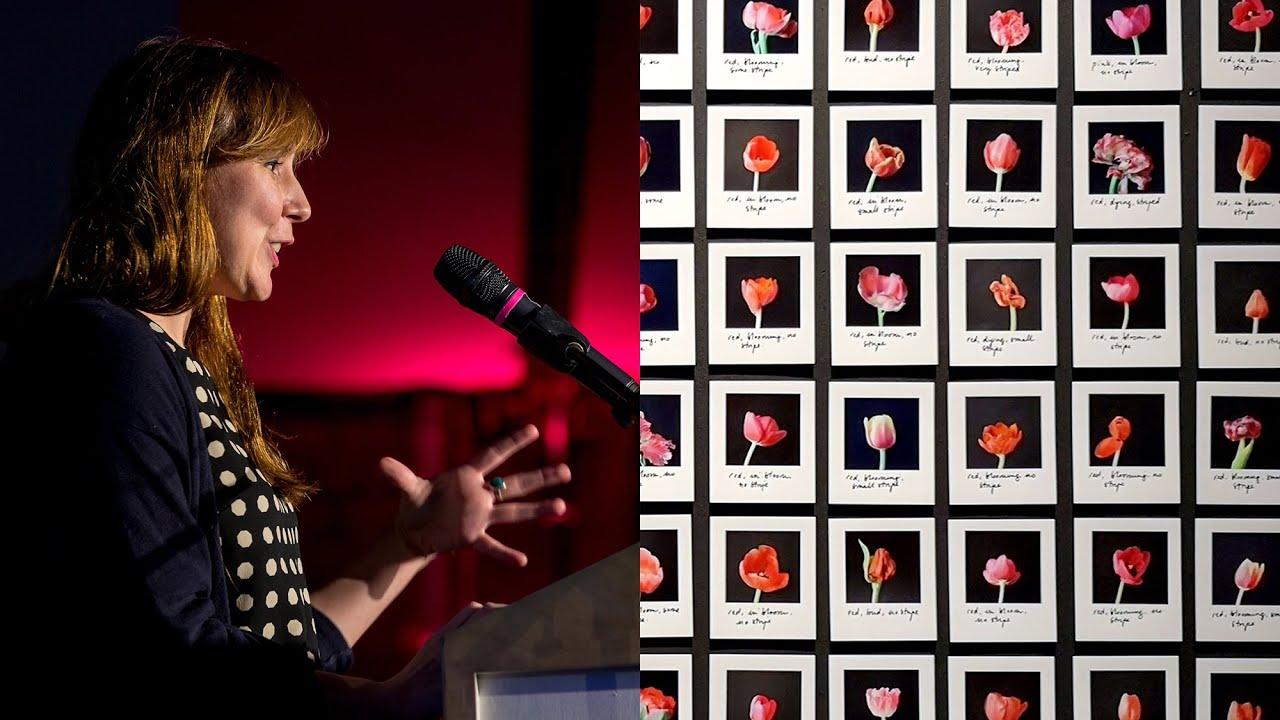
“People talk about artificial intelligence but really it is this incredibly human process — because people are involved in kind of compiling these datasets either in the source content or the process of labeling them, and these datasets always become this almost... they enshrine these cultural social attitudes.”
Right right yes so I'm gonna be talking about machine learning creativity and my cheela project or in ten minutes so hopefully this will all work.
So I don't know how many of you are familiar with machine learning or AI as that's kind of called in the media but when you're working with it you have kind of two main materials the data or the training set that's used I'm going to come back to you and the algorithm that is then run on earth that has been kind of fun creates and artificial intelligence the algorithms that I use and that I'm particularly interested in are those called a gang or a generative adversarial Network again is a form of unsupervised machine learning which is an example is playing on the screen now which and this is from 2016 which is basically ancient and machine learning terms and these networks kind of been notoriously unstable and not that well understood there this weird complex iterative process with many interdependencies and kind of like the best way to kind of think about how these things are made is by thinking of two different networks and one is a detective and one is a forger and the forger is kind of looking at all of the things that it could that it's been presented within the dataset and trying to produce something that looks like it could come from that and the detective is kind of looking at what the forger is producing and saying no no until it gets good enough that can produce something that looks like it could come from the dataset but as you can kind of see the images kind of like they're weird they're kind of not quite there. And this is kind of commonly known as dreaming or hallucinating and what's playing is not images that are parts of photographs that have been stitched together but pictures that have been entirely generated or imagined of what the AI thinks that it should be producing for the category in question. And this is a science experiment but for me the image is incredibly beautiful and have this like really weird meandering dreamlike quality the results that are recognizable but at the same time have these tails that show you that they're not real and these imperfections and traces of the process are the quality that I really love and want a question and work with but at the same time. There is a finite time that these traces exists if you look at the latest deep fake technology that came out last week it's almost impossible to tell that the image has been kind of created by a machine it looks like a real photograph and what the reason why I think this is so important is these mistakes and imperfection draws attention to the process and also what is wrong with the process because as soon as something becomes too smooth it stopped being noticeable and when it stops being noticeable people stop questioning it or challenging it and the reason why it's important and quest to question and challenge it there's been a lot of work that has been done recently on the problem of a dataset and by kind of people like Kate Crawford and Rocklin and people like that a dataset or training set the images or data that is given to as I mentioned the algorithm in order to provide the knowledge that it works with the data that is needed to use this is extremely large thousands and thousands sometimes millions of images and inputs and often proprietary because whereas it's very easy or relatively easy to get the algorithms that you need to run these models is so much harder and nearly impossible to get the data that you also need and the other thing that is really interesting about these training sets is that they although they're kind of compiled using lots of different ways people are always involved at some point in the process and this is why I kind of like people talk about artificial intelligence but really it is this incredibly human process and because people are involved in kind of compiling these datasets either in the source content content or the process of labeling them and stuff these datasets always kind of become this almost they enshrine these cultural social attitudes and one of the my favorite examples is from image and app Isis very canonical database that is often used in machine learning projects and how they define women I don't know if you can read down the left-hand side of the screen but it is basically either super sexualized or otherwise kind of like quite unpleasant and if you look at the images that are then associated with those those labels it gives a super narrow conventional account of what someone who is beautiful is you know very kind of young very sexualized and if you're working with machine learning it's so important to interrogate this it's virtually impossible to kind of look through all of the images in these kind of commercial databases or these databases that are often kind of behind a wall a commercial wall.
And so for me as a creative person the amount of control that I would have by using them what's been included or excluded what biases or prejudices are being replicated or repeated is it's almost impossible to work with that. And it's something that I'm incredibly interested in and thinking and thinking about so for me self generated data in my work is incredibly important either by making it myself constructing it by reading every kind of like part of it which I've done I've read the entire of WikiLeaks which drove me crazy it becomes a decisive creative act and there is an art to it I really like on Wikipedia how up until relatively recently British copyright law considered a database to be in literary work because of the amount of time and skill that goes into it but how do I use this playing on screen is the snippet of a project that was shown at the Barbican in the summer called mosaic virus which as was mentioned draws historical parallels from chillip mania that swept across the Netherlands in Europe in the 1630s to the speculation that is kind of currently ongoing around cryptocurrencies and I created this work where each still is generated using machine learning and shows the tulip blooming which is an updated version of a Dutch still live but the appearance of the tulip is controlled by the price of Bitcoin mosaic is the name of a virus that causes the stripes and the petal which they increase their desirability and help cause the speculative crisis during the time. And in this piece the stripes depend on the value of Bitcoin changing over time to show how the market fluctuates and the more striking it gets the higher the price and I wanted to draw together these ideas around capitalism value and the tangible and intangible nature of speculation and collapse from these two different and yet surprisingly similar moments in history. And I'm not the first person to make this connection even back in 2014 the president of the Dutch Central Bank was making it.
But I also wanted to use this form of AI not merely as a tool but as another way of understanding the subject matter so as I mentioned mosaic pirates gave these the stripes and started to help cause the speculative buying of the bulbs and I think it's really nice that it's one of the only known instances of a plant disease actually increasing the value of the infected plant but what happened was that you could have Chi lips that would be white one year.
And then strike the next because it was kind of the mosaic virus was caused by insect laying an egg in the bulb and because people didn't understand this at the time they did all sorts of crazy things like take a white tulip bulb and a red tulip bulb and cut them in half glue them together and hope that they would get stripy tulips there was this kind of weird kind of like language of alchemy and mystique around kind of what caused the stripes and it they and growers kind of deliberately wanted it to seem strange difficult and obtainable because they increased their value and this lack of understanding of the thing that caused the value reminded me so much of the rush towards blockchain when it started the Long Island iced tea company that just produced iced tea added changed its name to the long block cane corporation and the next day's shares in the company soared by 500% just because of the name.
And it's the same thing people don't understand what about what is driving the value but people just know that it's it's it's in a hype cycle and it's also worth noting but AI in in and of itself is in its middle of its own bubble and you can't kind of like open a newspaper or switch on the TV without kind of hearing about it.
So this is kind of one of the reasons for me why it felt appropriate to use machine learning and AI in this piece because the material is kind of reflecting the central concept of kind of speculation and bubbles and to make this piece I needed to construct a data set my own dataset I couldn't just go to Google and find chillip photographs on a black background so I took 10,000 photographs of Cheops luckily I was working in the Netherlands and got a grant from the EU so but I did end up spending about 800 euros on it. And this kind of this process of taking them is this big difference when you take the 10,000 photographs yourself and kind of scrape them off the internet and it inverts the usual process I think of using this technology because rather than speeding things up it really slows things down.
And it becomes like craft repetitive time-consuming but necessary in order to produce something beautiful and there is the skill to it if you make the dataset too big if there are too many images the results will be kind of 2-yard and not that interesting and the quirks and oddities that make it such an interesting medium to work with start to disappear but if it's too small it won't have enough information and become totally flummoxed and not produce anything or just one thing again and again and again and the other thing that I had to do once I had taken these 10,000 photographs was categorize them by hand because machine these kind of machines are very stupid it doesn't understand things I had to kind of tell it what type what color the Teaneck was what type of tea looked how striped it was whether it was a bird or dying and this is a huge amount of work. And it's work that is usually hidden and when I had done that I chose to make a separate work.
So this is actually on show. Now in the design museum and got nominated for design of a year I wanted to draw attention to this act of kind of like the human element that sits behind machine learning because the shiny robotic quality of much of the digital digital appears to me to kind of new to the messiness of the world.
And I'm interested in the opposite how you can use this to kind of maintain and accentuate the sense of human so I hand wrote all of the labels on everything and you can see yeah and you can start to have discussions particularly in a non-technical communities about this human decision-making that sits along the chain of AI and how it's not an absolute correct thing you can have a chill up and you start to work out whether it's white or pale pink that. Actually becomes very difficult if you're trying to do it in a consistent way orange or yellow and if it's difficult to do something for as simple as a flower it's incredibly difficult to do it for something as complex as gender and identity and then I presented it.
So the full thing is 50 square meters to present my dataset and because it's easy to forget in the digital age the information information is physical and the things that you see on a screen generated by a machine actually once stashed out in the real world and by placing things back in the real world people can start to comprehend aspects of it that they didn't before.
But the final thing that I wanted to leave on was despite all of this categorization and the months and months and months of work that I put into it it's a mistake to think that you ever have control with these things it's impossible to predict what will come out in each of the stills that I made my machine I can guess but I cannot know. And this for me is really exciting and makes it such a rich field for creative people to work with [Applause]
Latest Talks
-
Will Anderson and Ainslie Henderson
Bringing stop motion sorcery to BBC’s Small Prophets
Watch -
Amber Weaver
How does contemporary type design translate into the wider world?
Watch -
Murugiah
Why you should reject the formula and make art about things you love
Watch -
Marina Willer
Design thrives when you find poetry in the simple things
Watch -
Lizzy Stewart
The hundreds of drawings and writing-on-a-whim that goes into comic novels
Watch -
intra
The rewarding process of recognising the art in obscure everyday life
Watch