
Anna Malin Mantzaris is a Swedish animator known for her unique stop-motion animation style. Her recent film, Enough, which humorously explores themes of frustration and rebellion against daily life, has won over 30 international awards.
Anna Malin Mantzaris
Crafting a stop-motion ode to small rebellions in everyday mundane life
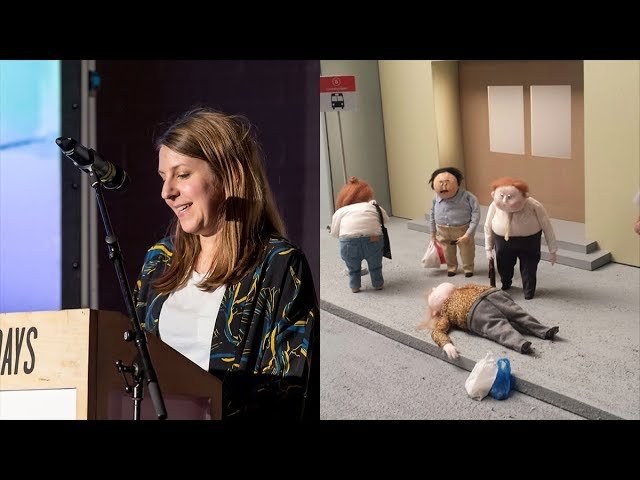
“I wanted to explore the feeling of having had enough and this notion of someone revolting against their normal life.”
Transcript: May contain minor errors or formatting inconsistencies.
Hello my name is Anna hello and my name is Ana Montes and I'm an animation director and an animator and I work at passion animation studios now. And I'm gonna show you a little bit how my work can look like but I'm mainly gonna talk about enough which is a short film that I made so here's some of my previous work.
But I'm here today to talk about this short film called enough and it's a two-minute film about what people. Actually want to do and I made it my first year when I went to RCA a Royal College of Art. And I'm just gonna show you the film first because only two minutes and then I'm going to talk you through the process ♪
but I say I get the Mercedes my weekend ♪
[Applause]
with the film thank you so when I started at the RCA I had I had done another film before which was a little bit successful and I felt like I'm gonna do something new and it's a bit scary and also I knew that when I was going into the second year it's gonna be much more pressure on the film that you make and more people is going to see it and more people are going to judge it.
So I was thinking okay but now I'm doing the first year film which is a much smaller project.
So I can be more brave and take more risks and experiment more and also I wanted to try something different because I made another film before.
So I just wanted to find like different approaches to the way of storytelling and so I just know I wanted to something which is not a classic story because I was like yeah if it doesn't work out no one is gonna see it. So it doesn't matter really.
And then I wanted to work with a feeling of someone getting enough for someone like revolting in the mundane life. And I had a lot of smaller ideas like someone quit in their job their opressing job in a very dramatic way or like all these small things that you really wanted to do but you really can't you can't do so I was playing around with his ideas but I didn't really find one which I felt like this is a short story.
And then I talked with a friend who was like but why don't you do all of them like as different moments and I really liked that idea. And I think also looking back I was also a little bit inspired from moving to London and taking the public transport in rush hour and I felt like there was a lot of like passive-aggressiveness boiling underneath and so some of my inspiration starting off like I really like the Swedish director Roy Anderson his work is very sad and mundane but also very funny and he his themes are a lot about like humanity and he has really nice atmosphere.
I think it's the two pictures to the left and I know I wanted this to feel very mundane and a grey and a bit sad so like the people almost feels like a bit oppressed in the environments and then. I really like their work of the directing do mark and Emma I really like they work with texture with felt and their characters are very sympathetic but also a little bit awkward and I really like the Swedish filmmaker Nikki alien dude from bar she also works with the mundane themes and like existential anxiety and boredom and this sort of things that I like so that's where.
I started and then I for this particular film I didn't have a script I just started to brainstorm in situations and like find as many as possible that I could and just put them on post-it note on the wall and tried to sort them. And I knew I didn't have time to make all of them so of course I needed to like it take take away that many of them. And some of them were too complex I wondered like I needed a crowd of puppets which I didn't have time to make some of them didn't really fit the team some of them were a bit too similar to each other.
And some of them were too like complex to explain in just a single shot so I started to sort these out. And so they were like fewer and fewer and when I had like a bunch of them I started to storyboard them straight away without the script and I started to try to edit them together and but I was struggling a bit because I didn't want them to feel like just a sequence of images that just felt cut off. And it could have been going on for ages so I wanted to even though there was just like single moments I wanted it to feel like an overall story or like in the bigger picture there's like some sense of story to it.
So I looked a bit up like story types and there is many more complex ways of like working with story and structure and so on.
But I just wanted to like take inspiration from the most simple way. So it was just like to start with a sympathy for the character and then go like more dramatic and then in the end have something which feels like some sort of catharsis or something like yeah that it's like ending off or it's giving you back something.
So I just like took a little bit of inspiration from this like most basic way.
So I'd tried to edit them. And so they were more soft ones first and then they become like more and more dramatic and then in the end it's like she's sort of giving up and letting down. And so like edited every shot shorter and shorter so there's like you could feel like there's a story curve throughout the film even though it's just many shots after each other so when I had them I did the storyboard and I edit them in the timeline as an animatic which you normally would do for animation just to plan it out.
And so you know how long it's short it's gonna be and so when that was planned I started to have to build everything. And I had like five between five and six months for this project was really little if you worked like mainly alone if you don't have like a big term and so I knew I had to keep the style really really simple in order to make it in time like I have to I couldn't like do all this intricate beautiful details it has to be like a bit harsh almost simple but I think it works in favor of the film because I think the main focus of the film was gonna be like the characters and their emotions and the staging so I wield a lot of buildings which I reused and rearranged in different ways in the different shots so it's actually the same buildings all the time and the same with the cars and also when you do the puppets for animation you need to have like in wire armature on the inside so you can animate them and because I didn't have time to make all the characters that I wanted to do in the film I made eight characters and then I reduced them for different shots so when I finished one shot I cut off their hair glue on new hair switch clothes put on some other clothes and then I could use them for another scene so from 8 puppets I made like 24 characters and it was like I said a little bit similar with the buildings that well as well that I reduced them. And I made most of that by myself a little bit kind of helping and I was like cutting up the fabric and fitting them to the characters and then giving them to my boyfriend who was doing the stitches and I was doing the next one and that's how we had to spend some Friday evenings but and then once I built everything he started to set up and yeah I worked with the cinematographer called Donna and she is that the lights to make it look like it's an environment and I wanted it to feel very mundane but it still feel a bit atmospheric and when you work with stop-motion it takes like so a long time to animate so you don't want to start to animating and accidentally knock something over so you have to glue like everything with glue gun really hard like every single little prop everything so you don't accidentally move it mid shot and here is another behind the scenes and because I when you make animation you you move the puppet a tiny bit you take a still picture you move the puppet a tiny bit you take a still picture and when you have 25 pictures you have one second of animation. So in a normal day you would do like three to five seconds which is like 75 to 125 pictures so you really want to know what you're doing before you don't want to be like oh let's try this.
So that's why you would like time the storyboard into an animatic but also I really liked to do like reference videos so you can decide beforehand because I think a lot in this like was depending on having a good timing and so I did like we did a lot of reference videos of me or other people that I forced to act for me and there was a lot of funny behind-the-scenes videos for this film but unfortunately I deleted most of them.
So I'm not going to show them.
But it really helped to watch them and observe like the acting in the timing and yeah then I basically animated it and five to six months and after that the film. Actually did like really well much better than I expected and it's won over 30 international awards and the VM your best of the year. And some other Wars and also many people have written to me like oh I'm so happy to say this I always wanted to do that or like I always wanted to slap someone on the bus. And so it's like many people who felt relieved to see it.
So I'm happy to hear that. And I get I think I got some negative as well someone was angry because I showed how to kill a baby but I don't really think I did that but and after that because it is I think also it's very short format so it really works to share online and you have time to see it rather than like 12-minute film I also got some like job offers from that so at the end of last year I did I don't have time to show that the film now.
But it's online but I did a work with Greenpeace France which they wanted to do like an anti-pollution commercial and they really they saw enough online and they really liked my style so they just asked if we could do it together. And we could use my style of puppets so it was really fun and it was really fun to work like for a good cause and borrow my style to that. And so yeah that was it thank you [Applause]
Latest Talks
-
Will Anderson and Ainslie Henderson
Bringing stop motion sorcery to BBC’s Small Prophets
Watch -
Amber Weaver
How does contemporary type design translate into the wider world?
Watch -
Murugiah
Why you should reject the formula and make art about things you love
Watch -
Marina Willer
Design thrives when you find poetry in the simple things
Watch -
Lizzy Stewart
The hundreds of drawings and writing-on-a-whim that goes into comic novels
Watch -
intra
The rewarding process of recognising the art in obscure everyday life
Watch