
Accept & Proceed
How a moon poster and kinetic sculpture led to designing for NASA
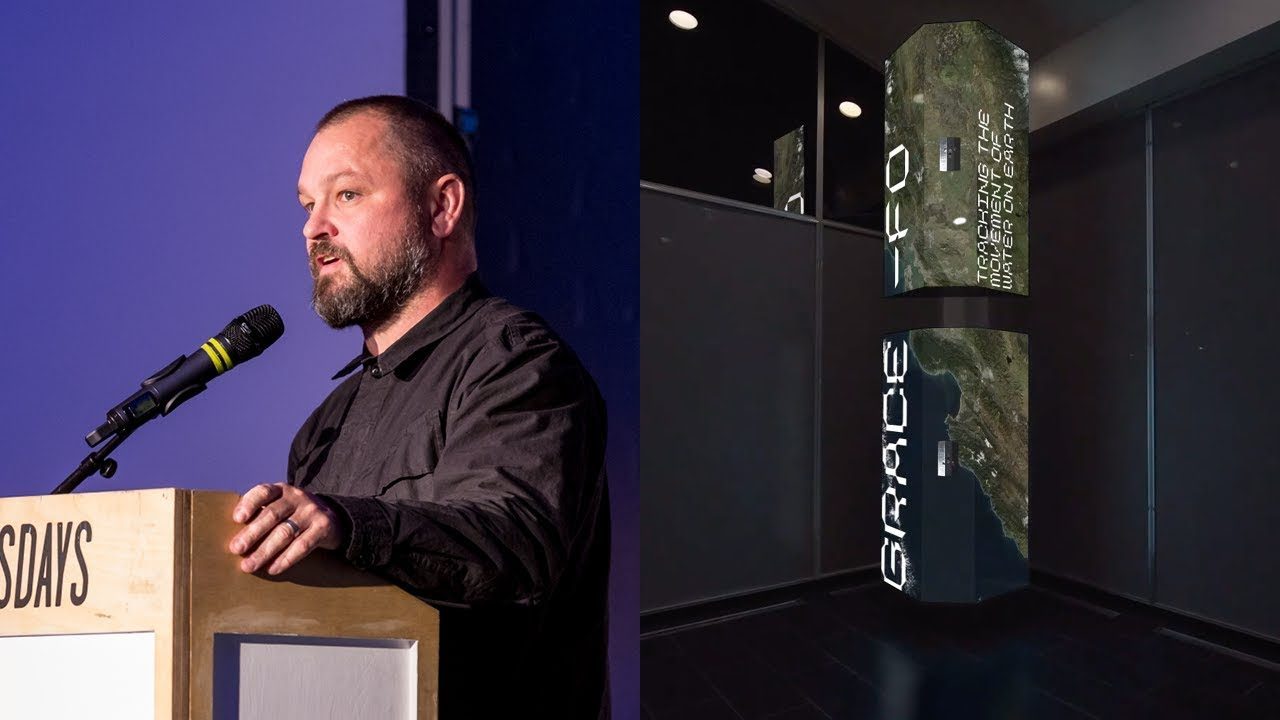
“Design doesn't work in a vacuum. It's about the relationship between us, the client and the project. The client knows their business and their customers and we know how to communicate their message. And together we mold great work.”
That's me. Hello.
So I'm going to tell you about the work we did for NASA's Jet Propulsion Lab last year and the personal work that led up to it. We are a graphic design agency with 13 years old. Our current stomping ground is around Hackney Downs, but as a team we come from all over the world. It's true.
I didn't. I work in a team. There's 20 of us. We all have our own roles and responsibilities and we all contribute to the work. Everything we do, we do as a collective. And here we are. What a beautiful bunch.
We have a formidable mix of the very best designers, strategists and project managers and even an in-house barista and two dogs. Parachuting in when necessary, we have a network of amazing collaborators too that can see us grow to maybe 30 or 40 people at times.
We also, believe it or not, see our clients as part of the team. What you don't see is the hundreds of people that have been on this journey with us over the past few years.
So we've got design principles that I'm going to talk you through. And all the best work we do is due to these design principles and we have three. The first one being thinkers one, the second one find the truth and the third make it resonate. And why do we have design principles? It's a lens for us to view everything we do through. When a work is on point, it's because we have followed these and in this order.
I want to go back to that one. So this is thinkers one.
This is all about collaboration. Design doesn't work in a vacuum. It's about the relationship between us, the client and the project. The client knows their business and their customers and we know how to communicate their message. And together we mold great work. The second one is find the truth.
Every project has a core value at its heart. Our goal is to find the one thing and amplify it, layering stories and relevant information as we go. The third one is make it resonate. We layer in meaning and depth. There we go. To create a greater bond between the viewer and the work, nothing we do is decoration. So I want to talk about explorations.
This is kind of our self-initiated work platform that we have. It's been in our DNA from the beginning. And two of the projects that we've done through our explorations are what led to us working for NASA.
Simply by exploring areas that we're interested in, amazing things have happened and come our way. I'm giving you a brief view of the look and feel of this new platform here. It's going to bring together all of our personal work past and present, but also the stuff in the future that we're working on. And currently we're working on a collaboration piece with the Grime MCP and also the new gen fashion designer, Bethany Williams.
So the first project I'm going to talk to you through is a poster we did based upon the moon landings. Some of you may know us for our light calendar series that we've done for the last 10, 12 years. And we've been exploring data visualization and print techniques ever since.
So this poster was something I had in mind for a while. Only 12 people have walked on the moon and these are the first two.
I think we all know about Apollo 11. Neil and Buzz went on the moon and then Collins had to circumnavigate the moon for a day while they were waiting for them to come back into a space module. But what people don't know is that they're actually on the moon for 22 hours and only two and a half hours they're actually walking along the moon. The other 19 and a half hours are stuck in that tin can on their own out in space. And I think when you start thinking about those extra layered meanings into these stories, that's when things start to resonate a little bit more.
So we're looking into this. Apollo 12, these are the astronauts again.
This is the second mission and they are two EVAs. That means getting out of their vehicle and they got to stand on the moon for over eight hours, these guys. Apollo 13 famously didn't make it. Tom Hanks and Kevin Bacon were supposed to land.
But they had to radio back to Houston with a problem. This guy, however, Alan Shepard on Apollo 14, he was a right joker. Somehow he managed to smuggle a load of golf balls onto the moon and a six iron. God knows how you smuggle that on. Very strange. And he became the first guy to tee off in space. This is Apollo 15.
This is when they first used the moon buggy. Cool as fuck. Apollo 16, they cut this one short. And finally Apollo 17. That was Apollo 17. That was the end of the moon, the space race. It was all over and time for everyone to come home. So how do you take this data and make a data graph out of it? How do you build it into a poster? Well, first of all, you plot the moon landings. 11, 12, 14, 15, 16 and 17. Notice they're all on the facing side of the moon. No one except Pink Floyd has actually been onto the dark side yet.
And then we added the type details. The circular effect here looks like the landing ripples of the moon dust as the lander touched down on the surface.
And then we had to add in that data. This talk of the hours spent on the moon was really interesting. So 22 hours for Apollo 11. Twice as long for 12 and then longer and longer as the missions went on, culminating in the astronauts spending 75 hours on the moon.
We also have the data of all the 80 or so other probes that we've also touched down on the surface. Here's a close-up of the design. And here's how the print looks. We spent a day with our screen printers to get all the eight layers of tints correct on this one. So Apollo 17, the whole mission was 12 days. They spent 75 hours in total on the moon. That's amazing.
That's three days eating, sleeping, living. Imagine falling asleep on the moon in your lunar module and then waking up. Fuck, I'm still on the moon. That'd be incredible. What do you dream about when you're in space? I've got no idea. Rather poetically, in 50 days time, on July the 16th, it's the 50th anniversary of the first moon landing.
So we're going to start to hear a lot about this in the news and stuff. The next, the next explorations that we did here is called Spectra. And it took the form of a kinetic sculpture in our studio. NASA gave out loads of their data freely and one of our teams saw that they had released data about meteor strikes to the moon. And we knew the project that we wanted to do here and we knew who we wanted to work with, a team called Field, Vera and Marcus. And we talked about doing a collaboration. And we built a huge, tessellated sheet that represented the flattened out moon.
And then we had it move to indicate 10 years of meteor strikes to the moon from 2000 to 2010 and compressed it into a three hour loop. Every time a meteor struck, the sheet would articulate. It looks like a render actually here, but it's real. And here you can see the program that ran the piece. Every pinprick of light is a new strike. We're a graphic design studio. So why are we creating a metallic motorized floating moon blanket sculpture? We're simply trying to test ourselves and tell stories and engage in ways. And these projects are a research that will one day hopefully feed into commercial projects.
The sculpture is made of 100 circuit boards, 36 motor modules and 56 stainless steel triangles and took well over 300 hours to put together. And you can see yourself on the screen somewhere, wherever you are. As with all art, you learn more about it the longer you live with it. We couldn't have predicted the effect the light would have on this piece. As the sun rose in the east every day and it shone off the reflectors, the light pinged through the studio and created a beautiful dappled effect. So once we've recently completed this piece, we employed a new commercial director and she couldn't believe how much time and money and energy we spent on this piece. What was the payoff? Well, we didn't actually know what the payoff would be, but it turned out it was huge. One of our clients saw it and suggested we showed it to the art studio at NASA's Jet Propulsion Lab.
So we chatted, the team liked our style and asked if we could work on the grace follow-on mission with them. It was about to launch and we're a set of brief. Grace means gravity, recovery and climate experiment. In 2002, they sent up two satellites whose job it was to measure the movement of water on earth. And they do it by moving around as a linked pair, the distance between them about 200 kilometers changes depending on the gravitational pull of the water moving below. From this, the scientists can tell where the sea level rises or glaciers mounting or aquifers drying up.
The satellites were dying, so they were sending up a new pair on one of Elon Musk's rockets. Our job was to celebrate the launch with a scale model of them in the reception of the Jet Propulsion Lab. The model satellites had screens on them that would display the info that the real satellites beamed down to earth. The brief was awesome, but obviously very complex, and we always liked to have proper face time with our clients. So on this occasion, I took one for the team and jumped on a plane to NASA, the Jet Propulsion Lab in Pasadena. Now, if you'd have told me as a 10-year-old that I'd be going to NASA as a job, as a jolly, I wouldn't have believed it.
Now we're actually working for them, so it's quite incredible. Pasadena is on the heels of the Atskirts of LA. It's where in the 1930s, crazy scientists test setting off rockets and controlled explosions way out of the way of the city below, where they could do less damage as things went wrong as they often did. It's literally grown from there, very organically. There's now 6,000 people working there. Buildings, offices, warehouses, engineering spaces.
They build space robots, remote control, space vehicles and satellites here. Pretty bloody epic. The team I was going to work with at JPI were two guys called David, and they met me at reception. You get a badge and an escort. You're not allowed to go anywhere on your own. So before going to the studio, you get a bit of a tour. You get to see ground control, which is just like you see on the films.
And then in a garage, near a parking lot, there was the Curiosity Rover, identical to the one currently on Mars. And when things go wrong up there, they problem solve the rover down here, and then send software updates up to Mars to fix things. They told me a bit of a story about this, which is quite funny. There's a rivalry between the different NASA departments and JPI do all the non-manned missions. The Curiosity Rover has holes in its tires, as you can see there.
This allows all the rubble out, but also leaves marks on the ground so they can see how far it's traveled. They have the gaps spell out JPL in Morse code. So you've got this rover going along Mars, graffitiing JPL on the ground as it goes, which is super cool. For us, we like to hide things in our work too, little secret messages and stuff.
So we realized we were working with the right people. We get to the design studio and we started whiteboarding. We try and work out some systems and then the scientists would swing by and they tell us where we'd misinterpreted the data or made something wrong or what we didn't, wasn't right. The installation had to be correct first and foremost, but readable to both senators and school children at the same time. They couldn't tell me who was the most intelligent of those two.
In fact, the designs had to be completely politically agnostic, just display the data. Far from being about space, it turned out that this project is about highlighting the climate emergency that we're now in the throes of here on Earth. The time difference between the West Coast and London meant we could scribble during the day, working out different ways the data could be displayed. I'd send them to London once the day was finished and they would draw up the designs while we were sleeping. It was like the shoemaker's elves crafting the work overnight, but in reality, it was just Nigel and his team in the office.
But I'd go in each day with new designs and we'd work on them and try and get everything right. So first of all, we worked on a display font for Grace. We saw it as giving her her voice, how she speaks her knowledge to the world on this earthbound installation. The font we designed is based on the shape of the satellites.
We have horizontal and vertical bars which join to make the letter forms.
Now they're combined to give you the message. The parts of the font are reliant on each other just like the satellites are. Individually, they don't work.
We had to work with a DPI grid as these were LED screens and we started with the numbers. And then went on to the full alphabet.
This is the coordinates of where we stand today. And this is the final piece.
So the final installation, if you go to JPL, you'll see in the reception. Water doesn't go anywhere. There's always 100% of all water ever on earth, still on earth. Sometimes it's ice, sometimes it's seawater or fresh water or clouds, but it doesn't go anywhere. It just changes form. We see the satellites over a particular part of the planet and then we zoom in to see that month's data. Fresh water drop off from the sea ice is happening quicker than ever. When we're in LA, one of the guys said they just had two days of rain last year and now they're mining water from the ground. It's millions of years old.
It will never be replaced. Hoping to create this installation brought home to us that we weren't just working with the cool logo. We're working with incredible people whose lives' work was dedicated to helping the planet for all of humanity. It was incredibly humbling. One last thing. You can trace back that NASA work directly back to that moon poster and the spectra installation. We never knew at the time what would come of it, but it felt right. Trust your instincts and do what feels good. Just try and work on the things that interest you and hopefully that should attract the kind of work to you that you want to do. Thank you.
Latest Talks
-
Will Anderson and Ainslie Henderson
Bringing stop motion sorcery to BBC’s Small Prophets
Watch -
Amber Weaver
How does contemporary type design translate into the wider world?
Watch -
Murugiah
Why you should reject the formula and make art about things you love
Watch -
Marina Willer
Design thrives when you find poetry in the simple things
Watch -
Lizzy Stewart
The hundreds of drawings and writing-on-a-whim that goes into comic novels
Watch -
intra
The rewarding process of recognising the art in obscure everyday life
Watch